Northern Thailand
Chiang Maiเชียงใหม่
The best-value city in Thailand for nine months of the year — and genuinely hard to live in for the other three
In short
Chiang Mai is a small city with a big reputation: a 700-year-old walled centre, a mountain at the end of the road, rents a third below Bangkok's, and an internet connection good enough to run a business on. It is also a city with no public transport worth the name and an annual smoke season that regularly makes it the most polluted place on earth. Almost every decision about living here — which district, which building, which months to be in the country — comes back to those two facts.
Suits you if
- Remote workers who want a real cost advantage over Bangkok without losing infrastructure
- Retirees on a fixed income — the same money goes 30–40% further than in the capital
- Anyone whose life is built around mountains, cycling, running or riding
- Families who want a house and a garden rather than a 35-square-metre condo
- People who want to live somewhere that still feels Thai rather than international
Think twice if
- The burning season. From roughly February to April the air is genuinely dangerous — PM2.5 hit 188 µg/m³ on 29 March 2026, twelve times the WHO guideline, and the city ranked first in the world for pollution more than once that month
- There is no mass transit. Songthaews are not a transport system, the city bus has been cut back repeatedly, and the light rail is not due to open before 2032
- A scooter is the default answer to every transport question, and road deaths in Thailand are among the highest in the world
- The Ping River flooded to 5.3 metres at Nawarat Bridge in late 2024 — the worst in fifty years — and put Chang Khlan and the Night Bazaar under a metre of water
- Rents rose 7.3% in the second quarter of 2026 alone; the ฿10,000 Nimman condo of 2018 does not exist any more
- Healthcare is good but shallower than Bangkok's — complex cases still travel south
Chiang Mai is the city foreigners in Thailand recommend to each other, and it has been for about fifteen years. The reasons are real: you can rent a decent one-bedroom for what a parking space costs in Sathorn, ride to a 1,600-metre mountain in forty minutes, eat extremely well for ฿60 a plate, and get fibre internet that averages faster than most of Europe. It is a small, legible, largely low-rise city with a moat around the middle of it.
The case against is equally concrete, and most guides bury it. For roughly ten weeks a year the air here is among the worst on the planet. There is no functioning public transport, which means a scooter, and scooters are how foreigners in Thailand most often get killed. And the arithmetic that made the place famous has moved — Chiang Mai in 2026 is cheap relative to Bangkok, not cheap in absolute terms. Anyone deciding whether to move here is really deciding whether they can live with those three things.
Chiang Mai at a glance
- 1BR rent, city centre
- ฿15,700
- Citywide median, July 2026. ฿9,300 outside the centre; ฿25,000+ in prime Nimman
- Monthly cost, one person
- ฿30,000–45,000
- Rent included, living comfortably rather than frugally
- Worst air months
- Feb–Apr
- PM2.5 reached 188 µg/m³ on 29 March 2026 against a WHO guideline of 15
- Rail stations
- 0
- The light rail's first 5 km line is pencilled in for December 2032
- Average fixed-line speed
- 171 Mb/s
- AIS, twelve months to March 2026 — the practical reason people work from here
- Direct flights
- 30 destinations
- 12 countries, roughly 82 departures a day from an airport ten minutes from the moat
The moat is the mental model#
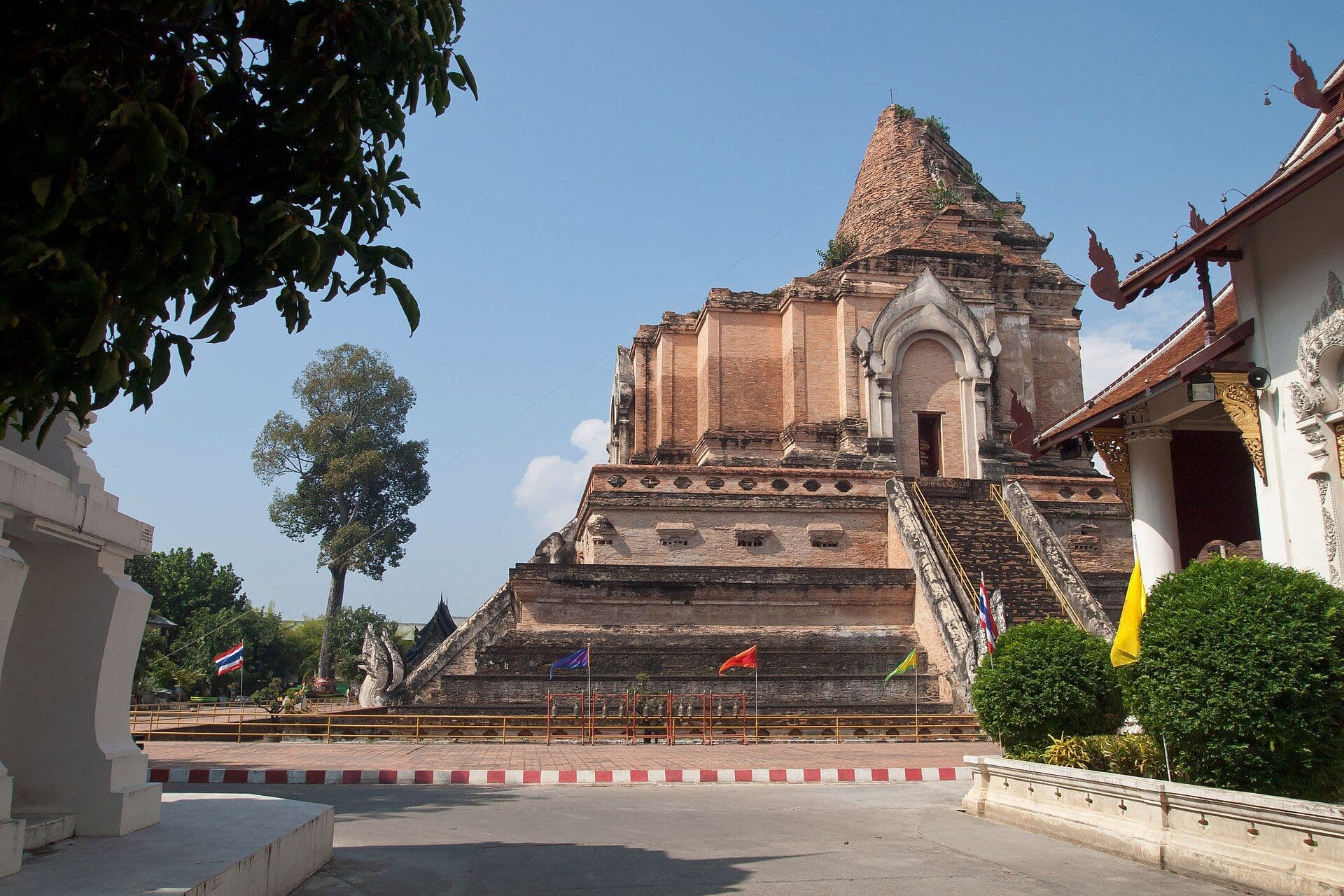
Bangkok is organised by rail line. Chiang Mai is organised by a square. The old city is a walled and moated block roughly 1.6 kilometres on each side, laid out in 1296, and every address in the city is described by its relationship to it: inside the moat, or a certain number of minutes from a particular gate. Tha Phae Gate on the east side is the default meeting point and the eastern axis runs from there down Tha Phae Road towards the Ping River, Warorot Market and the Night Bazaar on Chang Khlan Road.
West of the moat, across the Huay Kaew Road, is Nimmanhaemin — the condo, coffee and coworking district, and the address most foreigners arrive at. North of Nimman and west of the moat's top corner sits Santitham, an ordinary Thai neighbourhood that happens to be five minutes from all of it and 30–40% cheaper. Beyond that the city loosens into the ring roads: Hang Dong to the south, Mae Rim north up the valley, San Kamphaeng east along the 1006, all of them within half an hour of the moat and all of them requiring a vehicle.
The permanent compass point is Doi Suthep, the 1,676-metre mountain on the western edge. It is visible from most of the city, it is where everyone runs and rides, and on the bad days in March you cannot see it from Nimman at all, which is how residents judge the air before they check an app.
The practical consequence is that Chiang Mai has no rent-versus-transit trade-off in the way Bangkok does. What you are trading is distance against dependence: inside the moat and in Nimman you can live on foot and by bicycle, and everywhere else you need a scooter or a car. That single decision determines more about daily life here than the neighbourhood name does.
What Chiang Mai actually costs#
The figures circulating online are usually a decade out of date. Numbeo's July 2026 crawl puts a one-bedroom in the centre at ฿15,662 and outside the centre at ฿9,315, with non-rent costs for one person at about ฿18,160 a month. That produces a realistic single-person total of ฿30,000–45,000 depending on whether you rent in Nimman or Santitham and whether you eat Thai or Western.
The direction of travel matters more than the level. Chiang Mai rents rose 7.3% in the second quarter of 2026, and one-bedroom asking prices in central Nimman and around the old city now run ฿18,000–28,000 against ฿16,500–25,500 a year earlier. The city is still materially cheaper than Bangkok — roughly a third less for an equivalent life — but the ฿500-a-month studio that built the reputation has not existed since about 2017.
| Item | Modest | Comfortable |
|---|---|---|
| 1BR, Santitham or outside the centre | ฿7,000–10,000 | ฿15,000–22,000 |
| Electricity, water, building fee | ฿900–1,600 | ฿2,500–4,000 |
| Fibre internet | ฿590 | ฿900 |
| Mobile | ฿300 | ฿500 |
| Food | ฿7,000 | ฿14,000 |
| Transport (scooter, songthaew, Grab) | ฿1,500 | ฿3,500 |
| Health insurance | ฿2,500 | ฿7,000 |
| Gym, coworking, everything else | ฿3,000 | ฿9,000 |
| Total | ฿23,000–27,000 | ฿52,000–61,000 |
Rent from Numbeo (July 2026) and Chiang Mai agency listings (April–July 2026); sources disagree by 15–25% at the top end because prime Nimman new-builds and Thai-market apartments are quoted in the same breath. Electricity assumes a landlord sub-meter at ฿6–8 a unit, which is normal here, and the high figure assumes air-conditioning through March to May.
Price the whole thing yourself with the cost of living calculator, which prices the same lifestyle in every Thai city side by side. If you are here more than 180 days in a calendar year you also need to read Thai tax residency before, not after, you move money into the country.
The burning season, at length#
This is the single most important thing to understand about Chiang Mai, and it is the thing the city's boosters are most practised at minimising. Every year, from roughly February to late April, agricultural residue burning across northern Thailand, Myanmar and Laos combines with forest fires, a temperature inversion and a bowl-shaped valley to fill the city with smoke. It is not haze. It is fine particulate matter at concentrations that would trigger emergency measures in most of the world.
The 2026 season was a bad one but not an outlier. Between 1 January and 27 March, 2,090 hotspots were recorded in the province; on 24 March alone there were 158 active wildfires across 15 districts. On 29 March, PM2.5 in Chiang Mai reached 188 µg/m³ with an AQI of 263 — twelve times the WHO's 15 µg/m³ daily guideline. IQAir ranked Chiang Mai the most polluted major city in the world on 30 March, and among the top ten repeatedly through the month. Samoeng and Hot districts were declared wildfire disaster zones and KA-32 helicopters were deployed.
The province's response is a blanket open-burning ban, this year running 1 February to 31 May, plus fire crews, disaster declarations and public advisories. It has never solved the problem, for the straightforward reason that much of the smoke originates outside the province and a good deal of it outside the country. Nobody currently expects the next five years to look meaningfully different from the last five.
It also has second-order effects that a prospective resident should price in. Tourism collapses: Songkran-period hotel occupancy in 2026 ran around 60% against roughly 90% in a good year, and businesses that depend on the season struggle. A visible share of the foreign population leaves for six to eight weeks, which thins out coworking spaces, gyms and social life exactly when you might most want them. Landlords know this, which is why signing a lease in March is the cheapest time of year to do it.
The honest summary is this. For about nine months of the year Chiang Mai has unremarkable air and, from November to January, some of the pleasantest weather in Thailand — 15–28°C, dry, clear. For about ten weeks it is a city where going for a run is a bad idea, where sensitive people get bronchitis, and where the mountain you moved here for is invisible. If you have asthma, a heart condition, small children or a respiratory history, treat this as disqualifying rather than as an inconvenience to be managed.
| Months | Weather | Air | What it is like |
|---|---|---|---|
| Nov–Jan | Cool, dry, 15–28°C | Usually good | The reason people move here. Loy Krathong and Yi Peng fall in November. |
| Feb–Apr | Hot and dry, 35°C+ by April | Hazardous | Burning season. Peaks in March. Many residents leave. |
| May–Jun | Hot, first storms | Clearing fast | The rains scrub the air within days of arriving. |
| Jul–Oct | Wet, humid, 25–33°C | Good | Green, quiet and cheap. Also when the Ping is watched closely. |
Air-quality characterisations follow IQAir's 2026 season reporting and the Pollution Control Department's burning-ban calendar; weather ranges are long-run monthly means, not forecasts.
Healthcare#
Chiang Mai's healthcare is good, cheap by international standards, and genuinely a tier below Bangkok's. Two private hospitals hold JCI accreditation — Bangkok Hospital Chiang Mai on the eastern ring road and Chiang Mai Ram near the northern moat corner — and between them they cover most of what a foreign resident will ever need, in English, usually the same day. A basic consultation with an X-ray at Chiang Mai Ram runs about ฿1,900.
The value option is Sriphat Medical Centre, the private wing of Chiang Mai University's medical faculty, which is staffed by the same consultants as the teaching hospital next door at a fraction of Bangkok Hospital's prices. Maharaj Nakorn Chiang Mai — everyone calls it Suan Dok — is the public teaching hospital behind it: excellent, cheap and extremely crowded. Lanna and McCormick cover everyday private care at lower prices again, and Nakornping is the main public hospital north of the city.
The limit is depth. For rare oncology, complex cardiac surgery or anything requiring a sub-specialist, the referral path still runs to Bangkok — a 70-minute flight — and serious insurance policies assume that. Budget for it rather than discovering it. Emergency ambulance is 1669.
| Hospital | Type | Best used for |
|---|---|---|
| Bangkok Hospital Chiang Mai | Private, JCI | Complex care, insurance-direct billing, the widest specialist bench |
| Chiang Mai Ram | Private, JCI | Walk-in consultations, diagnostics, the default expat hospital |
| Sriphat Medical Centre | University private wing | Surgery and specialist care at a third to a half of private prices |
| Maharaj Nakorn (Suan Dok) | Public teaching | Serious cases on a budget; expect long waits |
| Lanna / McCormick | Private, mid-tier | Everyday illness, minor procedures, dentistry |
| Nakornping | Public | North of the city; the main hospital for Mae Rim and San Sai |
Consultation prices vary several-fold between the first and third rows for identical work. Confirm whether your policy direct-bills before you need it.
Getting around a city with no public transport#
Say this plainly, because most guides do not: Chiang Mai has no public transport system. It has red songthaews — shared pickup trucks that run no fixed route and no timetable. You flag one down, say where you are going, and the driver either nods or drives off. Fares in town have drifted from ฿30 to ฿40 a person and are negotiable in a way that reliably costs foreigners more. It works. It is not a network, and you cannot plan a working day around it.
The RTC city bus exists, charges a flat ฿30 and covers a handful of routes with air-conditioning and an app. It has been restructured and cut repeatedly — route 24C was dropped in mid-2025 — and no resident builds a commute on it. The light rail that would fix this has been studied since 1996; the current programme has a 5 km first line reaching final approval in 2027, construction possibly starting in 2028 and opening in December 2032. Plan around what exists.
So: Grab for convenience (฿60–200 for most trips in town, with bikes cheaper than cars), and a scooter for everything else. Monthly scooter rental runs ฿2,800–4,500 for a 125cc, and it is what the overwhelming majority of long-stay foreigners here actually do. Be clear-eyed about it — Thailand has one of the world's highest road-fatality rates, motorbikes account for most of it, and a helmet plus an international licence plus insurance that actually covers motorcycles is the minimum. Riding without the correct licence usually voids the policy.
The compensation is that distances are small. The moat to Nimman is ten minutes. The airport is ten minutes from the old city. Doi Suthep's summit is forty. In Bangkok you organise your life to avoid crossing town; here, crossing town is not a consideration.
Internet, coworking and the nomad scene, honestly#
The infrastructure is the real thing. Six providers offer fibre; AIS averaged 171 Mb/s in the twelve months to March 2026, packages run ฿590–1,200 a month, and outages are rare enough that people forget to complain about them. For remote work this is a better connection than most of the cities people move here from.
The coworking layer is mature rather than growing. Punspace (the original, ฿3,500–4,000 a month), Yellow, Alt_ChiangMai (฿4,000 and the nicest room in the city), Hub53 and the free-if-you-buy-coffee CAMP at Maya are the ones people actually use, and they cluster in Nimman and around the old city.
As for the scene itself: Chiang Mai invented the modern digital-nomad hub between roughly 2013 and 2018, and a good deal of its reputation is inherited from that period rather than earned currently. The community is still here and still the largest in Thailand, but it is older, quieter, more professionalised and considerably more expensive than the mythology suggests, and it empties out every March. Bangkok has taken much of the serious-business end, and Da Nang and Bali have taken much of the cheap-and-social end. If you are coming for a specific city you have read about on a 2017 blog, come for a month first and see whether the 2026 version is the one you want.
Visas and immigration#
Most long-stay foreigners here are on a retirement extension, an education visa, a marriage extension, or increasingly the DTV, which suits Chiang Mai's population of remote workers better than anything that came before it. Chiang Mai Immigration sits on Airport Road in Suthep, with a branch at Promenada handling extensions, 90-day reporting and student cases. Both are busy; both are far more workable than Bangkok's Chaeng Watthana.
Two operational points. First, DTV holders extend for ฿1,900 and should file at day 165–175, not day 179 — the queue is the constraint, not the rule. Second, if your plan involves hopping the border, note that visa-exempt entrants are limited to two land crossings per calendar year. From Chiang Mai the workable route is Chiang Khong to Huay Xai in Laos (three to five hours, ฿500–800); Mae Sai is a day trip rather than a strategy. After two land entries you are flying. Keep your 90-day reports and extension dates in one place — our deadline tracker exists for exactly this.
Who Chiang Mai suits — and who it does not#
- It works well if you want the outdoors: mountains, road cycling, trail running, riding. Nowhere else in Thailand puts that at the end of a ten-minute drive.
- It works well if you are cost-sensitive but not cost-desperate. The same standard of living costs roughly a third less than in Bangkok.
- It works well if you want a house and a garden. ฿20,000–35,000 rents a three-bedroom with outdoor space in Hang Dong or San Kamphaeng.
- It works well if you can leave for six weeks in the spring, or genuinely do not mind being indoors for them.
- It works badly if anyone in the household has asthma, COPD, a heart condition or is very young or very old. The February-to-April exposure is not manageable by willpower.
- It works badly if you will not ride a scooter and cannot afford daily Grab. This is the single most common reason people find Chiang Mai smaller than they expected.
- It works badly if you need a deep professional market — corporate law, banking, a large employer, a specialist consultant. That is Bangkok.
- It works badly if you want a coastline, or nightlife past 1am, or the anonymity of a big city. Chiang Mai is a small town that a lot of people have heard of.
Common questions about living in Chiang Mai
How much money do I need per month to live in Chiang Mai?
฿25,000 a month is genuinely liveable: a Thai-market one-bedroom in Santitham or outside the centre, street food, a scooter, no international-hospital insurance. ฿38,000 is the comfortable middle — a modern condo, a mix of Thai and Western eating, insurance, a gym. Above ฿60,000 you are into house-and-car territory in Hang Dong or Mae Rim, which is where most families end up.
Is the burning season really that bad?
Yes. In March 2026 Chiang Mai was ranked the most polluted major city in the world, with PM2.5 at 188 µg/m³ on 29 March against a WHO guideline of 15, and 2,090 fire hotspots recorded in the province in the first three months of the year. It lasts roughly ten weeks, from February to late April, and no year in the last decade has been meaningfully clean. Residents cope with sealed rooms, purifiers, masks and, very often, by leaving.
Do I need a scooter?
Effectively, yes, unless you live inside the moat or in Nimman and are content to walk, cycle and use Grab. There is no metro, no meaningful bus network and no reliable timetabled anything. Rental runs ฿2,800–4,500 a month. Get the correct licence — riding on a car licence or none at all is the standard way foreigners find out their insurance does not cover them.
Chiang Mai or Bangkok?
Bangkok if you need a professional network, world-class hospitals, direct long-haul flights or genuine urban depth. Chiang Mai if you want lower costs, mountains at the door and a city small enough to know. Bangkok's air is bad for about four months; Chiang Mai's is worse for about three. Neither is clean.
Which area should I live in first?
Nimmanhaemin if you want short leases, cafés, coworking and other foreigners within walking distance — it is expensive by local standards and worth it for a first three months. Santitham if you would rather keep 30–40% of the rent and are willing to ride five minutes. The old city if the point of moving here was to live somewhere old and walk.
Is Chiang Mai still good for digital nomads?
It is still good; it is no longer exceptional. The fibre is excellent, the coworking spaces are mature and the cost advantage over Bangkok is real. But rents rose 7.3% in Q2 2026 alone, the community is smaller and older than its reputation, and it empties out during the smoke season. Come for a month before committing to a year.
Does Chiang Mai flood?
The Ping River rose to 5.3 metres at Nawarat Bridge between late September and early October 2024 — the highest since the early 1970s — putting Chang Khlan Road, the Night Bazaar and Warorot Market under as much as a metre of water. The old city and the western districts were far less affected. If you are renting near the river, ask specifically what happened in October 2024 and do not take a ground-floor unit.
How is the healthcare compared with Bangkok?
Very good for everyday and most serious care, and cheaper: two JCI-accredited private hospitals, a university hospital and its lower-cost private wing at Sriphat. The gap is sub-specialist depth. For rare cancers or complex cardiac work the referral is to Bangkok, and any policy you buy should assume that trip.
Chiang Mai neighbourhood guides