Central Thailand
Bangkokกรุงเทพมหานคร
Southeast Asia's most functional big city — if you learn to live along the rail line
In short
Bangkok is a city of roughly six million registered residents and eleven million people in practice, organised less by district than by proximity to a BTS or MRT station. Life here is unusually good value for what you get: world-class hospitals, food at every price point, and a rail network that has quietly doubled in the last decade. The costs are real too — three to four months a year of genuinely unhealthy air, heat that makes walking a chore for half the year, and traffic that punishes anyone who guesses wrong about where to live.
Suits you if
- Remote workers who want a real city rather than a beach town
- Anyone who values fast, affordable private healthcare
- Food obsessives — the depth here is not matched anywhere in the region
- Families willing to pay for international schools and space
- Entrepreneurs who need flights, banks, lawyers and staff in one place
Think twice if
- PM2.5 pollution from roughly December to April, peaking in January and February
- Heat and humidity that make a 900-metre walk a decision, not a default
- Traffic that turns a six-kilometre trip into 50 minutes at the wrong hour
- Rent premiums of 2–3× for the handful of fashionable sois
- Flash flooding in the rainy season, and long-term subsidence risk
- The 20-baht flat rail fare applies to Thai nationals only — foreigners pay full price
Bangkok rewards people who understand one thing before they sign a lease: this is not a city you navigate by district, it is a city you navigate by station. Two people living four kilometres apart can have completely different lives depending on whether each of them is a five-minute walk from a BTS platform or a fifteen-minute motorbike ride from one. Almost every complaint foreigners have about Bangkok — the traffic, the cost, the sense of being trapped indoors — traces back to that single decision.
What you get in exchange is a genuinely functional metropolis. Hospitals that treat patients from 180 countries. A rail network that has grown from two lines to eleven. Food that ranges from ฿50 boat noodles to three Michelin stars, often on the same street. And a cost of living that, for a single person living well rather than lavishly, still lands somewhere between ฿45,000 and ฿65,000 a month.
Bangkok at a glance
- 1BR rent, city centre
- ฿22,800
- Citywide median. ฿11,200 outside the centre; ฿55,000 in Thonglor
- Monthly cost, one person
- ฿45,000–65,000
- Rent included, living modestly but comfortably
- Rail stations
- ≈140
- BTS, MRT, monorails and the Gold Line — nearly 200 including commuter rail
- Worst air months
- Dec–Apr
- Citywide PM2.5 hit 58 µg/m³ in January 2026, against a 37.5 standard
- Population
- ≈11 million
- 5.8m registered in the city proper; 17m in the wider region
- Rainy season
- May–Oct
- Cleanest air of the year, and the months when streets flood
Source: Numbeo cost of living, Bangkok
The rail map is the mental model#
Bangkok has no grid and no meaningful centre. What it has instead is a spine: the BTS Skytrain, two elevated lines totalling around 60 stations, crossing at Siam. The Sukhumvit Line runs north–south then east along Sukhumvit Road, through Asoke, Phrom Phong, Thonglor, Ekkamai and out past Bang Na to Kheha in Samut Prakan. The Silom Line runs from the National Stadium down through Sala Daeng and Chong Nonsi to Bang Wa across the river.
Underneath and around it sits the MRT. The Blue Line is the workhorse — 38 stations over 48 kilometres, now a full loop that connects Sukhumvit, Silom, Chinatown, Rattanakosin's edge and Thonburi. The Purple Line (16 stations) runs north-west into Nonthaburi. Two monorails opened in 2023: the Yellow Line (23 stations, Lat Phrao to Samrong) and the Pink Line (32 stations, across the northern suburbs). The Gold Line is three stations long and exists mainly to serve ICONSIAM.
The practical consequence is that Bangkok's rent map is a distance-to-station map. Moving two sois back from a main road can cut a comparable unit's rent by ฿5,000–8,000 a month; moving one station further out can do the same. That is the single biggest lever you have over your cost of living here.
The gap in the network is the old city. Rattanakosin — the Grand Palace, Wat Pho, Khao San — is served by exactly one MRT station at Sanam Chai, and everything else is a walk, a boat or a taxi. The Orange Line will eventually help, but its eastern section is not expected before late 2027 and the western section, the part that reaches the old town, is scheduled for 2030.
What Bangkok actually costs#
Ignore both the ฿30,000-a-month blog posts and the ฿150,000 expat-package figures. Neither describes how most foreign residents live. A single person renting a decent one-bedroom within walking distance of a station, eating a mix of street food and restaurants, and carrying health insurance lands in the ฿45,000–65,000 range. Numbeo's July 2026 figures put non-rent costs for one person at about ฿23,700, which matches that.
The variable that dominates everything is rent. Numbeo's citywide median for a one-bedroom in the centre is ฿22,785, but that median hides a spread from about ฿10,000 in Bang Phlat to ฿55,000 for a new building in Sathorn or Thonglor. Two identically qualified people can be ฿30,000 a month apart purely on address.
| Item | Modest | Comfortable |
|---|---|---|
| 1BR condo, walkable to a station | ฿15,000–20,000 | ฿28,000–38,000 |
| Electricity, water, building fee | ฿1,500–2,500 | ฿3,000–4,500 |
| Fibre internet | ฿600 | ฿800 |
| Mobile | ฿300 | ฿600 |
| Food | ฿9,000 | ฿18,000 |
| Transport (rail, Grab, motorbike taxi) | ฿2,000 | ฿4,500 |
| Health insurance | ฿2,500 | ฿7,000 |
| Gym, social, everything else | ฿4,000 | ฿10,000 |
| Total | ฿35,000–40,000 | ฿70,000–83,000 |
Rent figures from Numbeo (July 2026) and Bangkok agency listings (April–July 2026). Sources disagree by 10–20% on prime-area rents; treat any single number as the middle of a range. Electricity swings hard with air-conditioning — budget the top of the range from March to May.
Our full national breakdown lives at cost of living in Thailand; if you are budgeting a move rather than a visit, start there and treat Bangkok as the expensive end of the country.
Air quality and the burning season#
This is the part most Bangkok guides underplay, and it is the single most common reason people leave. From roughly December to April, the north-east monsoon brings dry continental air, rainfall stops, the mixing layer drops, and everything the city emits — plus agricultural burning across the central plains — sits on top of it.
In January 2026 the citywide PM2.5 average reached 58.1 µg/m³, against a Thai 24-hour standard of 37.5 and a WHO guideline of 15. Individual districts logged 79–108 µg/m³. On those days the air is not a nuisance; it is a measurable health exposure, and schools periodically move activities indoors.
The honest guidance is straightforward. May through October is the good half of the year — the rain scrubs the air, and Bangkok's air quality is unremarkable. December through April, you need a plan: a real HEPA purifier sized for your bedroom (not a desk gadget), the habit of checking AQI before deciding whether to run outdoors, and N95 masks for the worst weeks. People with asthma, small children or existing respiratory conditions should treat February in Bangkok as a genuine argument for spending it somewhere else.
It is worth knowing that Bangkok is not the worst of it. Chiang Mai and the north have a sharper, more concentrated burning season from February to April. If you are choosing between the two on air alone, Bangkok is the better of two imperfect options.
Healthcare#
Private healthcare is the thing Bangkok does better than almost anywhere at the price. Appointments are same-day or next-day, English is standard at the international hospitals, and you can walk into a specialist without a referral. Bumrungrad International on Sukhumvit Soi 3 is the best known — it treated more than 604,000 patients from over 180 countries in 2025, and is the only Thai hospital in Newsweek's top 100 worldwide for 2026. It is also the most expensive.
Samitivej Sukhumvit on Soi 49 is the default for families in the Phrom Phong–Thonglor corridor and has a well-regarded children's hospital on the same campus. BNH on Convent Road in Silom is smaller, calmer and considerably cheaper for routine work, which is why long-term residents in the business district use it. Piyavate near MRT Phra Ram 9 sits a tier below the marquee names on price and is perfectly competent for ordinary care. MedPark on Rama IV, next to the convention centre, is the newest of the serious tertiary hospitals.
Cost discipline matters. The same blood panel can differ by 2–3× between Bumrungrad and a good mid-tier hospital, and international hospitals bill per line item. For anything routine, use a mid-tier hospital; save the international names for complex care, or for the times when you want to be certain of the English.
| Hospital | Location | Nearest station | Best used for |
|---|---|---|---|
| Bumrungrad International | Sukhumvit Soi 3 | BTS Nana / Ploenchit | Complex care, second opinions, medical travel |
| Samitivej Sukhumvit | Sukhumvit Soi 49 | BTS Thong Lo / Phrom Phong | Families, paediatrics, maternity |
| BNH Hospital | Convent Rd, Silom | BTS Sala Daeng / MRT Si Lom | Routine care in the CBD, better value |
| Piyavate Hospital | New Phetchaburi Rd | MRT Phra Ram 9 | Everyday care at mid-tier pricing |
| MedPark Hospital | Rama IV Rd | MRT Queen Sirikit National Convention Centre | Tertiary and specialist care |
Nearest-station walking times vary from three to fifteen minutes; Bumrungrad and Samitivej both run shuttle vans from the BTS.
Getting around#
Rail first, always. A BTS or MRT trip is priced roughly ฿17–62 depending on distance and is the only mode in the city with a predictable journey time. Grab and Bolt are cheap by international standards — most inner-city rides are ฿80–200 — but they are hostage to the same traffic as everyone else, and a rush-hour ride from Silom to Thonglor can take 50 minutes.
Motorbike taxis, the orange-vested riders at the mouth of every soi, solve the last-kilometre problem. A ฿20–40 ride from the station to your building is what makes a soi-deep condo liveable. They are also the least safe way to move around the city; helmets are legally required and often nominally provided.
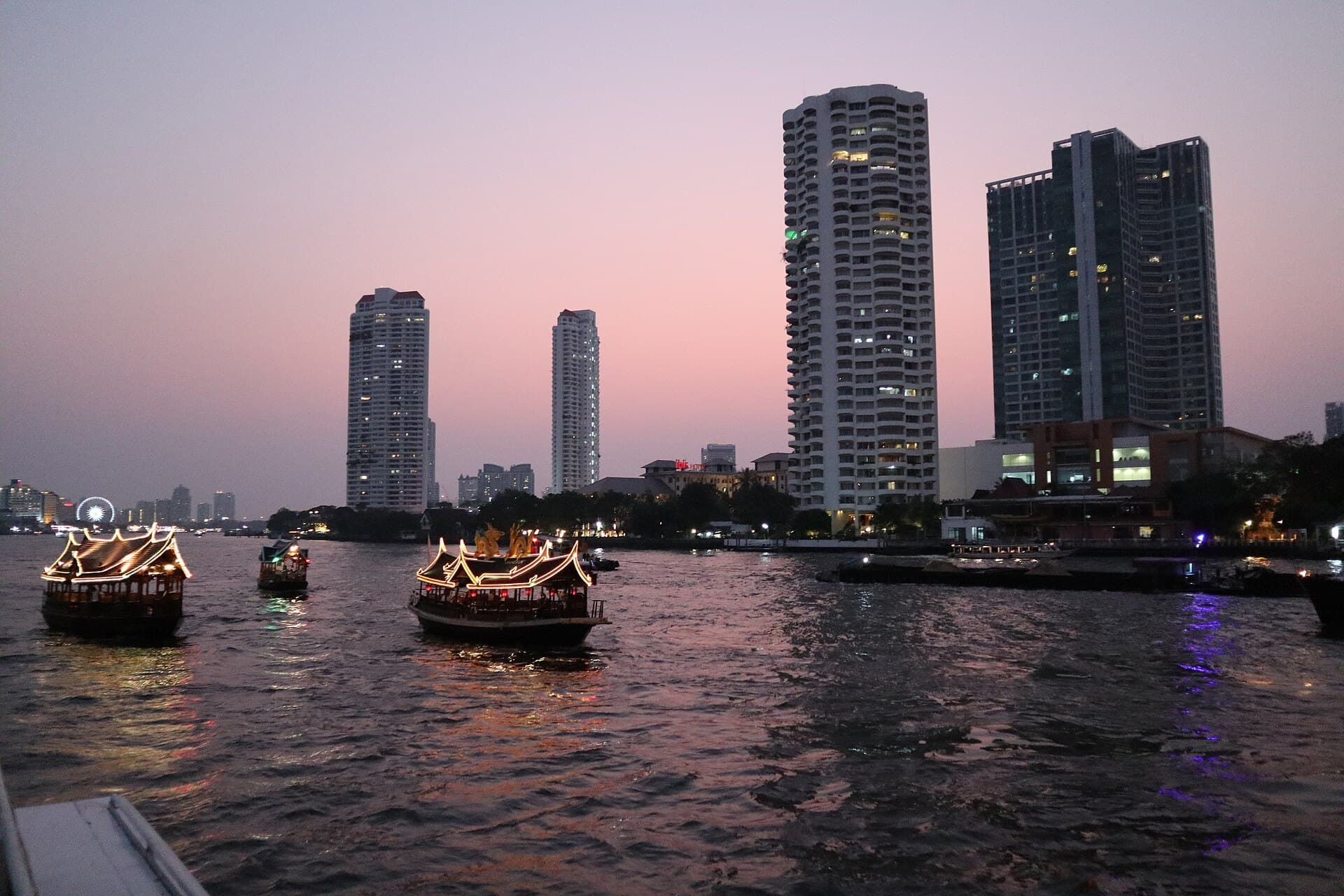
The river is underrated. The Chao Phraya Express Boat and the orange-flag commuter boats run from Nonthaburi down past Rattanakosin to Sathorn pier, connecting to the BTS at Saphan Taksin, and on a clear morning it is the most pleasant commute in the city. The khlong boats along Saen Saep are faster and considerably less pleasant.
Driving is a choice, not a necessity. Parking in the inner city is expensive and traffic is genuinely bad. Most long-term foreign residents in central Bangkok do not own a car; most in Bang Na and the outer east do.
Flooding, heat and the longer view#
Bangkok sits on a river delta barely a metre above sea level, on soft clay that is still compacting. Sea level in the Gulf is rising 1.3–2.3 cm a year once subsidence is counted, and Thai water-management researchers have publicly warned of a plausible major flood event between 2030 and 2034 if drainage investment does not keep pace.
The everyday version is more mundane: a heavy downpour between May and October will flood streets for two to four hours. In one 2026 storm, 57 areas across the city flooded at once. Khlong Toei, Bang Sue, Don Mueang, Lat Phrao, Min Buri and parts of Ratchathewi and Pathum Wan are the districts that flood most reliably; Sukhumvit Road itself sits close to mean sea level and Soi 39 and Soi 49 are notorious for standing water.
Practical mitigation is unglamorous. Do not rent a ground-floor unit in a low-lying soi. Ask the building manager, not the agent, how the soi drained last October. And accept that during the rainy season, plans made for 5pm on a wet Tuesday are provisional.
Heat is the other constant. Bangkok is hot year-round and brutal from March to May, when 35–38°C with high humidity is normal. This is why walkability in Bangkok means something different than it does in Lisbon: 400 metres is walkable, 900 metres is a decision, and covered skywalks and mall corridors are legitimate infrastructure.
Who Bangkok suits — and who it does not#
Bangkok is a genuinely great city for a specific kind of person and a frustrating one for others. Being honest about which you are will save you a year.
- It works well if you want a real city — theatres, specialists, direct flights, a professional network — rather than a lifestyle destination.
- It works well if healthcare access matters to you, whether because of age, a condition, or a family.
- It works well if you are an indoor-life person: air-conditioned gym, air-conditioned office, good restaurants, purifier at home.
- It works well if you are building something. Bangkok has the lawyers, accountants, staff and banking depth that Chiang Mai and the islands do not.
- It works badly if your daily happiness depends on being outdoors — running, cycling, hiking. Three to four months a year the air makes that a bad idea, and the heat handles the rest.
- It works badly if you are optimising purely for cost. Chiang Mai, Khon Kaen and Hua Hin will all beat Bangkok by 30–50% at the same standard of living.
- It works badly if you want a quiet, close-knit community by default. Bangkok is large and transient; friendship here takes deliberate effort.
- It works badly if you need silence. Construction, sois that never close, and a soundscape that does not stop are the price of density.
Common questions about living in Bangkok
How much money do I need per month to live in Bangkok?
฿35,000–40,000 a month is a real but tight budget: a small condo one or two stations outside the core, mostly street food, no international-hospital insurance. ฿55,000 buys a comfortable version of the same life. Above ฿80,000 you are into prime-address territory — Thonglor, Sathorn, a family-sized unit — and the marginal gain per baht drops fast.
Which Bangkok neighbourhood is best for a first move?
Sukhumvit–Asoke for most people: two interchange stations, everything within reach, easy short leases, and enough English-language infrastructure that you can get set up in a week. Once you know the city, cheaper and more interesting options open up — Ari and Charoen Krung in particular.
Is the air quality in Bangkok really that bad?
For about four months a year, yes. January and February routinely produce citywide PM2.5 averages three to four times the WHO guideline, and 2026 was no exception. From May to October the air is unremarkable. Most long-term residents run a HEPA purifier at home year-round and adjust outdoor exercise between December and April.
Can I live in Bangkok without speaking Thai?
Yes, and tens of thousands of people do — but it constrains where you can live. Along the BTS Sukhumvit corridor and in Sathorn, English is common enough to be functional. In Bang Na, Rattanakosin, or anywhere off the rail network, basic Thai stops being optional. Learning to read the script, which takes a few weeks, disproportionately improves daily life.
Do I need a car in Bangkok?
Not if you live centrally. Rail plus Grab plus motorbike taxis covers almost everything, and parking and traffic make a car a liability inside the ring. If you settle in Bang Na, the outer east, or Nonthaburi — or you have school runs — the calculation flips.
What visa do most foreigners in Bangkok use?
It depends on why you are here. Remote workers increasingly use the DTV visa, which allows long stays without Thai employment. Employed foreigners hold a Non-B with a work permit; over-50s use the retirement route. None of these permits you to take a job with a Thai employer without a work permit, whatever the visa.
Is Bangkok safe?
Violent crime against foreigners is rare and Bangkok is comfortable to walk at night in most central areas. The real risks are traffic — motorbike accidents are the single largest cause of foreign fatalities in Thailand — scams around gems, tailoring and rental deposits, and air quality. Ordinary urban precautions cover the rest.
How bad is the flooding?
Street flooding for a few hours after heavy rain is routine from May to October and is an inconvenience, not a danger. The serious concern is structural: Bangkok is roughly a metre above sea level and subsiding, and researchers have flagged 2030–2034 as a plausible window for a major event. It is a reason to rent above the ground floor, and a reason to think carefully before buying.
Bangkok neighbourhood guides