Religious
Phuket Vegetarian Festivalประเพณีถือศีลกินผัก
Nine days of strict vegan observance in Phuket's Hokkien-Chinese community, punctuated by public self-mortification
- Next
- In 2 weeks
- 10–18 October 2026
- Where
- Phuket Town, Kathu, Tha Rua, Trang, Bangkok Chinatown, Hat Yai
- Public holiday
- No
- Alcohol sales
- Normal
In short
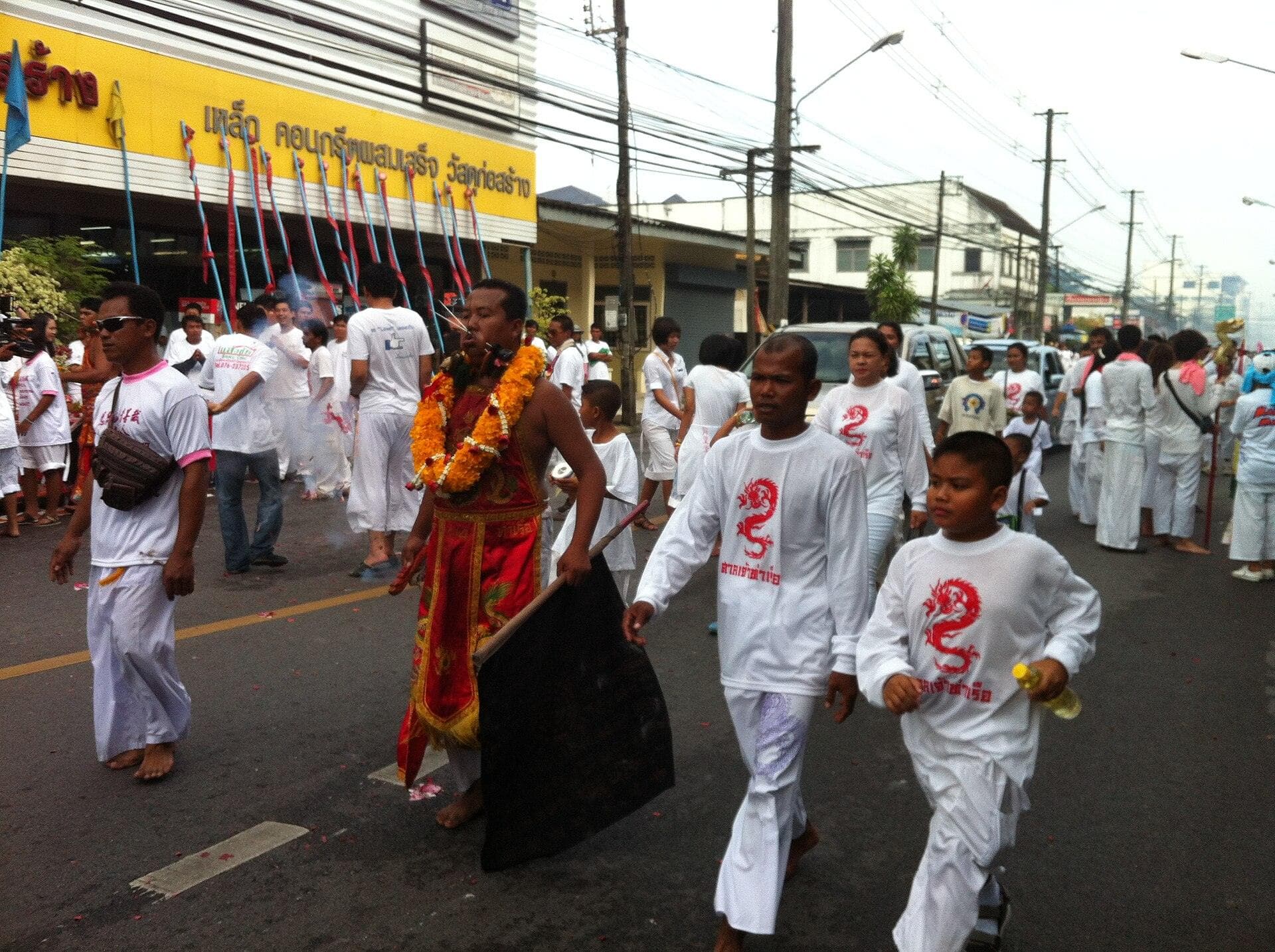
Held over the first nine days of the ninth Chinese lunar month, the Nine Emperor Gods festival is Phuket's largest and strangest event. Most of it is a food festival: the whole island eats vegan, shrines feed thousands for free, and yellow flags mark every participating kitchen. The part that draws cameras is the ma song — entranced spirit mediums who process through Phuket Town with skewers, blades and objects driven through their cheeks. It is not a spectacle staged for visitors and it is genuinely confronting.
Go if
- Anyone interested in food — this is the best week of the year to eat in Phuket Town
- Old Phuket Town's Sino-Portuguese shophouse streets, which are closed to traffic and lined with stalls
- Documentary photographers, with the caveat that consent and distance both matter here
- Vegans, who for nine days have the run of a country that is otherwise difficult
Be aware
- The piercing and blade-walking rituals are graphic. There is blood, and no barrier between you and it
- Firecrackers are thrown by the box at processions, at ankle height, continuously. Ear protection and closed shoes are not optional
- Processions start between 06:00 and 07:00 and the good positions are taken well before dawn
- Hotel rates in Phuket Town rise sharply and rooms go six to eight weeks out
- Participants wear white; visitors are expected to as well, and to abstain from meat and alcohol inside shrine grounds
The Phuket Vegetarian Festival is two things at once and it helps to separate them early. It is a nine-day communal fast observed by a large part of the island — no meat, no dairy, no alcohol, no garlic or onion, white clothing, and thousands of free meals served at the shrines. It is also a set of processions in which entranced mediums walk through Phuket Town with metal driven through their faces. Most visitors come for the second and stay for the first.
How the nine days are structured#
The shape of the festival
Typically Ten days including the eveThe eve — pole raising
A tall bamboo pole is raised at Jui Tui Shrine to invite the Nine Emperor Gods down. Lanterns are hoisted at each participating shrine. Quiet, ceremonial, and worth attending precisely because almost no visitors do.
Takes EveningDays one to eight — street processions
Each major shrine takes a morning. Processions leave at dawn, wind through Old Town for three to five hours, and are met by households who set up altars outside their doors and detonate firecrackers as the palanquins pass. This is where the ma song appear.
Takes 06:00–11:00 dailyThroughout — fire walking and blade ladders
Held in shrine courtyards in the evenings. Devotees cross beds of burning charcoal or climb ladders with blade rungs. Crowded, hot, and much closer than you expect.
Takes EveningsThe final night — farewell at Saphan Hin
The gods are sent off at the Kio Thian Keng shrine on the Saphan Hin waterfront around midnight, with the heaviest firecracker use of the whole festival. If you attend one thing, attend this, and stand well back.
Takes Late evening to past midnight
The shrines that matter#
- Jui Tui Shrine, Phuket Town — the largest and the opening venue. Adjacent to Put Jaw, the island's oldest Chinese temple.
- Bang Neow Shrine, Phuket Town — the other major town shrine, and the one with the most intense processions.
- Kathu Shrine — believed to be where the tradition began in 1825, after a visiting Chinese opera troupe recovered from illness by adopting the fast. Smaller, quieter, more devotional.
- Tha Rua Shrine, north of town — worth the drive if you want the ritual without the crowd density.
- Kio Thian Keng, Saphan Hin — the closing ceremony.
Practical planning#
Stay in Phuket Town, not on the west-coast beaches. The processions run through the Old Town streets and start before dawn; a 45-minute taxi from Patong at 05:30 defeats the purpose. Book six to eight weeks ahead — the Old Town's small hotels and shophouse guesthouses are the first to fill and they are not numerous.
Wear white. It is not a rule imposed on visitors, but it is universal among participants and standing in a black t-shirt in a crowd of several thousand people in white marks you out unnecessarily. Closed shoes, long trousers, and ear protection or plugs — the firecrackers are thrown in strings directly into the road and the noise at close range is physically painful.
All the ceremonies and processions are free. Budget for food, which is the point: the shrines serve free vegan meals to anyone who turns up, and the stalls along Ranong and Ratsada roads run for the full nine days at ฿40–80 a dish.
Common questions
Do I have to eat vegan to attend?
No, but you should not carry meat into shrine grounds, and the courtesy of eating jay food during the festival is easy to extend when it is the best food available anyway. Look for the yellow-and-red flags with the Thai character for jay.
Is it suitable for children?
The food and the street atmosphere, yes. The processions and firecrackers, no — both for the imagery and for the genuine risk of burns and hearing damage at close range.
Is it only in Phuket?
No. Trang, Hat Yai, Bangkok's Yaowarat and much of the peninsula observe the same nine days, and Bangkok's version is a large and much gentler food festival. The mediums and the mortification rituals are strongly associated with Phuket and southern Thailand.
Is alcohol banned during the festival?
Not by law. Abstinence is part of the observance and many Phuket Town venues close or stop serving voluntarily, but there is no statutory ban and the beach resorts operate normally.
Dates
The first nine days of the ninth month of the Chinese lunar calendar, normally falling between late September and late October. A pole-raising ceremony at Jui Tui Shrine on the eve opens the festival, and a farewell ceremony at Saphan Hin closes it on the final night.
- 10–18 October 2026Pole-raising on the eve of 9 October; final farewell at Kio Thian Keng shrine, Saphan Hin, on the night of the 18th.
Sources
- Phuket 101 — Phuket Vegetarian Festival dates and programmechecked 2026-07-26
- Michelin Guide Thailand — Phuket Vegetarian Festivalchecked 2026-07-26
What’s on
Calendar →- Full Moon PartyOn now26 September 2026 · Haad Rin Beach, Koh Phangan
- Phuket Vegetarian FestivalIn 2 weeks10–18 October 2026 · Phuket Town
- King Bhumibol Memorial DayIn 2 weeks13 October 2026 · Nationwide
- Ork PhansaIn 4 weeks26 October 2026 · Nationwide
- Surin Elephant Round-upIn 8 weeks19–21 November 2026 · Surin town